Bringing your baby home from the NICU is a milestone you dream about from the very first day you walk into the unit. After weeks of monitors, specialists, and round-the-clock care, walking out the hospital doors with your own baby can feel like both the moment you’ve been waiting for and the scariest transition yet. Scary because you realise ‘they’re trusting you to do this alone henceforth.’
If you’re preparing to bring your preemie home from the NICU, or have just walked through that door for the first time, here’s what can help make the transition a little smoother.
We spoke with Dr. Aruna Parekh, a neonatologist and Medical Director of the High-Risk Clinic at Stony Brook Children’s Hospital, and Debbie Gerken, a certified NICU nurse, certified pediatric sleep coach, and Founder of Sleep Like a Baby Consulting, to walk through exactly what to expect, how to prepare your home, and how to care for your preemie once you’re there.
When can my baby go home?
What does my baby need to achieve before coming home?
There’s no single calendar date for discharge from neonatal intensive care unit or NICU. Instead, your care team looks for a specific set of readiness signs, usually appearing close to your baby’s original due date.
In practice, that means they look for these three signs before discharging your preemie baby:
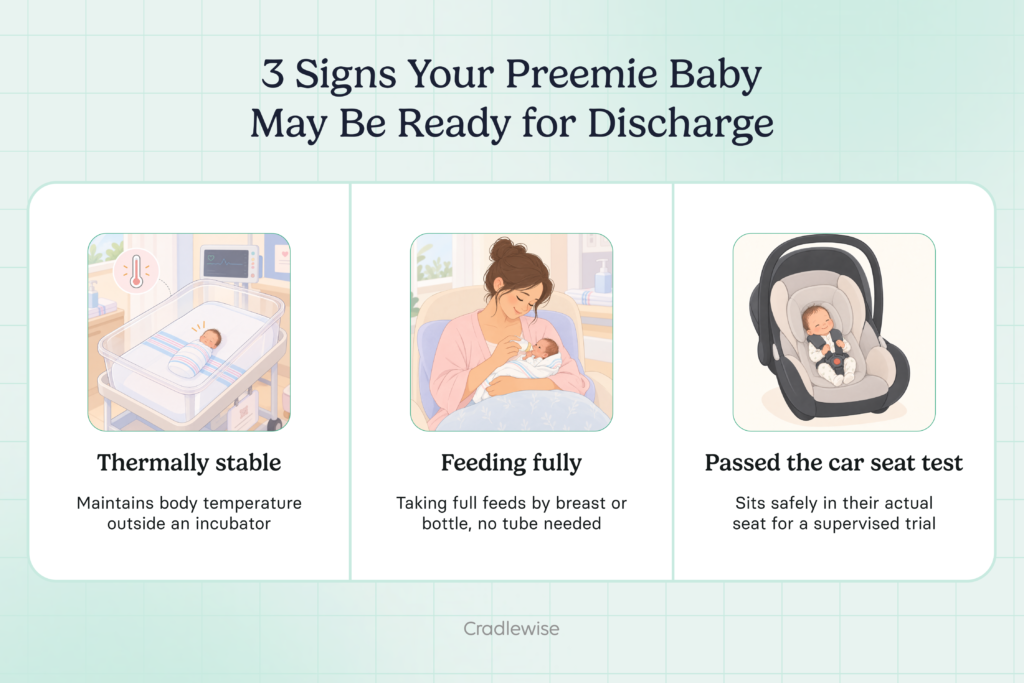
Babies with a more complex hospital course, including cardiac, pulmonary, surgical, or neurological care, may need additional support to reach these same milestones.
Cradlewise Note: Discharge planning often starts weeks before the actual day. Many NICUs hold weekly rounds involving physicians, nurses, psychologists, social workers, therapists, and dietitians, all coordinating around what your baby (and you) will need once you’re home.
What to expect when bringing a preemie home from the NICU
A few things to take care of before discharge day as per Dr. Parekh:
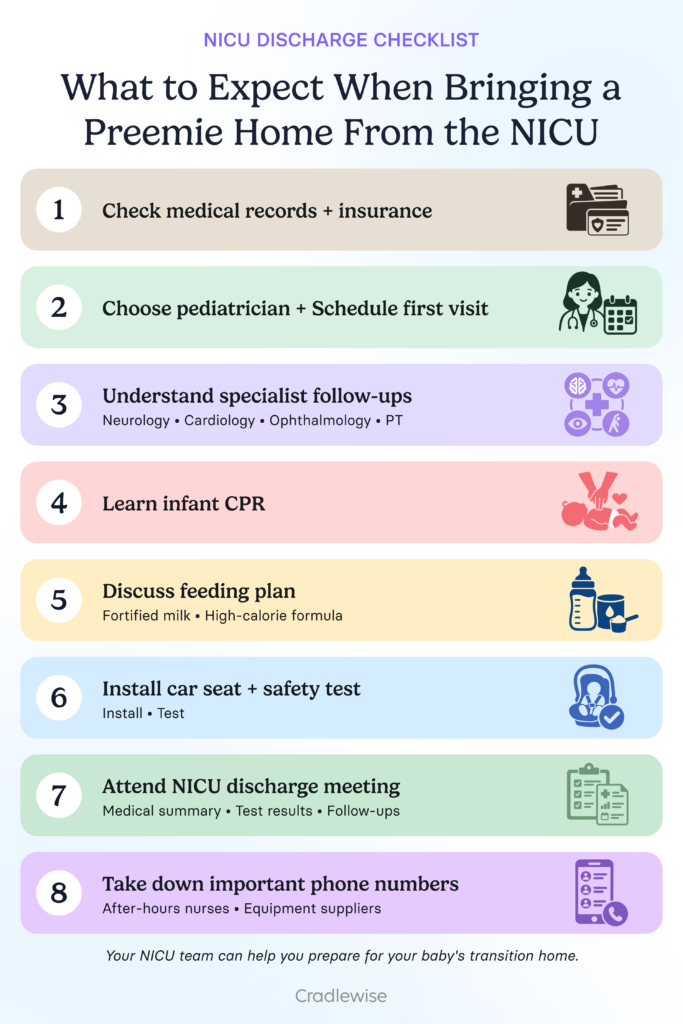
Practice hands-on care while you’re still in the NICU
As discharge gets closer, NICU staff will start involving you more directly in your baby’s care, holding, feeding, bathing, changing diapers, administering medicines, and handling equipment if your baby needs any, so you feel more prepared before you’re doing it solo.
Preparing your home for a preemie
Your preemie’s immune system is still catching up, so a few home adjustments help tremendously in those first weeks.
- Wash hands, yours and every visitor’s, before handling the baby
- Keep the room temperature between 68-72°F and avoid direct sunlight on your baby
- No smoking anywhere around the baby, including on clothing
- Create a quiet, low-stimulation space with dim lighting and soft baby sleep music
- Have essentials ready: preemie-size diapers and clothes, bottles, a smart crib or bassinet, and any specialty formula your doctor has prescribed
- Keep everyone in your household up to date on flu vaccine schedule and Tdap shots and other baby vaccine schedule to cocoon your baby from common illnesses
If your baby is going home with equipment, like a monitor, oxygen, or a feeding tube, your hospital team will train you thoroughly on how to use it before you leave.
When can preemie have visitors?
Visiting is a privilege and not something that parents owe other people. Premature babies, especially those who had significant respiratory concerns during their NICU stay, have more vulnerable lungs and immune systems than full-term babies. Hence, Debbie Gerken recommends protecting your baby by limiting and setting guidelines for people who visit, especially during RSV or the flu season.
“You don’t need to apologize for protecting the health of a baby who has already worked very hard to get home,” says Debbie Gerken. Your visitor rules, however strict, are entirely valid.
How to take care of your preemie at home
The day-to-day of caring for a preemie looks a lot like caring for any newborn, with a few extra layers of care around feeding, warmth, and rest.
Feeding your preemie at home
Debbie advises to watch for tiredness, color changes, coughing or gagging, and changes in breathing pace during feeds, and contact your baby’s medical team if you notice any of these.
Breastfeeding your premature baby
Debbie adds: It’s perfectly fine to supplement with a bottle of breast milk, and make sure to pump to protect your milk supply. Ultimately, growth takes priority over the way they are fed.
Dr. Aruna Parekh recommends the following:
- If your baby is formula-fed, feed them every 3 hours.
- Breastfed babies typically feed 8 to 10 times a day, and shouldn’t be sleeping through the night yet.
- Arrange for a prescription for a specialized formula in advance.
- If your baby was sent home on a special or premature-infant formula, check with your doctor before switching to anything else.
Bathing your preemie safely
One of the biggest considerations with a premature baby is temperature regulation, as smaller and younger preemies can lose body heat quickly.
Take heed of the following advice from Dr. Parekh and Debbie:
- Avoid daily baths.
- Never leave your baby unattended during a bath, not even for a second.
- Preemie skin is especially delicate and prone to injury, so follow any specific skin-care guidance from discharge, particularly around surgical sites, tube placement areas, or healing skin.
- Do not use any powder or skin products except in diaper areas, if needed. You can consider the use of zinc oxide.
The following blog on how to bathe your newborn, can be a good step-by-step guide.
Adjusting emotionally for your preemie
Parents go through many emotions as they see a lot of things during their NICU stay. That is trauma for parents and often gets overlooked as they get into the day-to-day caring for their baby at home. Work through that trauma by talking with your partner, family, or a professional.
Cradlewise Note: Many NICU parent support groups are available; online and in person. Some of them are: Postpartum Support International, Project NICU, NICU Parent Network, and Hand to Hold. However, such peer-to-peer support groups can complement and supplement, but cannot replace the services provided by professional NICU staff.
Sleep routine for preemies
NICU life doesn’t exactly make for smooth circadian rhythms. Preemie babies often nap in short bursts and don’t usually settle into longer nighttime stretches. Most won’t sleep a solid 6 to 8 hours until around 6-8 months corrected age.
Cueing ‘day versus night’ from the start, with bright, active days and dim, quiet nights, can help set the rhythm over time.
To know more about how preemie babies sleep, read our preterm baby sleep guide.
Safe sleep for preemies
Safe sleep guidance for preemies is the same as for any newborn. To protect from SIDS (Sudden Infant Death Syndrome) and other sleep-related dangers, remember:
- Always place your baby on their back
- Always on a firm, flat surface
- Cover the mattress with only a fitted sheet
- Keep the crib empty
- Swaddles or sleep sacks instead of loose blankets
- Room-share (not bed-share) for at least 6 months
For a full walkthrough, see our safe sleep checklist.
Beyond the practical care, simple connection matters too. Skin-to-skin time, reading and singing, and gentle play all support your baby’s development, alongside consistent feeding and sleeping routines that help both of you find a rhythm.
Car seat safety for preemies
Preemies pass a car seat test before discharge, but these few safety basics by Dr. Aruna Parekh can help you well beyond that first ride home.
- All babies under 2 must ride rear-facing, by law in most states
- Your baby must be secured in the car seat every time, even if they’re crying or fussing
- The car seat must fit your baby’s current weight and height, not just their age
- Replace the car seat after any accident, even if it looks undamaged
- Check the expiration date on your car seat and replace it once it’s expired
When to call the doctor or 911
Most days at home will be uneventful, but it helps to know exactly what warrants a call. However, Dr. Aruna Parekh recommends you to notify your pediatrician if you notice:
- Poor feeding or refusing to feed
- Jaundice, or yellowish skin color
- A temperature of 100.4°F or higher, or below 97°F rectal
- Redness or yellowish discharge from the umbilical area
- Excessive crying, vomiting, or unusually little or excessive stooling
Call 911 or go to the emergency room immediately for:
- Difficulty breathing, blue or gray coloring around the lips or face
- A limp or unresponsive baby
- A seizure
Cradlewise Note: If something feels off, call. No question is too small. No instinct is silly. You are your baby’s best advocate, and your care team wants to hear from you.
When is a premature baby considered “out of danger”?
Dr. Parekh adds: As the baby’s lungs, immune system, feeding skills, and nervous system mature, and as they demonstrate consistent growth and remain medically stable, the concerns associated with prematurity generally decrease.
Hence, document every little milestone, and celebrate it. Whether it’s a full feed without spit-up or a longer stretch between night feeds, it’s progress, even if it feels tiny at the moment.
Conclusion
Worrying about every little symptom, feeling isolated from limiting visitors, or carrying more than you’ve had space to process, all of it is common.
If vigilance is preventing you from sleeping, even when the baby is safely asleep, causing significant distress or interfering with daily functioning, Debbie Gerken encourages you to consult your healthcare provider.
Remember you are not alone in this, nor you have to do this alone. Let people help. Whether it’s a friend or your family members to take the load off of you, or your pediatrician and fellow NICU parents, there are people ready to support you as you and your partner find your footing at home.
FAQs
Q: Is it safe to bathe a premature baby who was in the NICU?
A: Yes, with a few extra precautions. Keep baths short, the room comfortably warm, and have a warm towel ready to wrap your baby in immediately afterward, since preemies lose body heat quickly. Follow any specific skin-care guidance from discharge, and avoid daily bathing.
Q: Will I need any special equipment for my NICU baby?
A: Some babies go home on a monitor, oxygen, or a feeding tube, depending on their hospital course. If so, your NICU team will train you thoroughly on how to use it before discharge.
Q: When can my preemie have visitors?
A: That’s largely your call. Many NICU nurses encourage strict visitor guidelines early on: no visitors showing signs of illness, limited numbers at a time, careful hand-washing, and no kissing the baby, especially during RSV season.
Q: What's the earliest a baby can typically come home from the NICU?
A: Most babies go home close to their original due date, once they’re thermally stable, feeding fully by breast or bottle, and have passed a car seat test. The exact timing depends entirely on your baby’s individual medical course.
Q: Is it normal to feel anxious after bringing my preemie home?
A: Yes. Losing the constant readouts from hospital monitors can feel like losing a safety net. Learning your own baby’s typical breathing, color, and feeding cues can help rebuild that confidence over time, and it’s okay to ask for support for yourself too.
You may also like:
- Wake windows by age: Your ultimate guide from birth to 12 months
- Safe sleep practices refresher: The do’s and don’ts of putting your baby to bed
- Does your baby cry in their sleep? Find out why
Sources:
- Flu vaccine schedule. CDC. 2025. Vaccine Schedules For You and Your Family.
- Circadian rhythms. J Dev Behav Pediatr. 2016. Circadian Sleep Patterns in Toddlers Born Preterm: Longitudinal Associations with Developmental and Health Concerns.
- Trauma during NICU stay. AAP. 2021. Parental Stress and Mental Health Symptoms in the NICU: Recognition and Interventions.
- Peer-to-peer support groups. J. Perinatol. 2015. Recommendations for peer-to-peer support for NICU parents.