You’ve pumped and you’ve tucked the bag in the fridge and now you’re not entirely sure if it’s been three days or four. Can you still use it? Is that slightly different smell normal? Why does the milk look grainy and curdled? What about the bag you took to the office? Can you carry expressed breast milk on the plane?
These are the questions that come up at 3 am, when your baby is hungry and you’re running on four hours of sleep. But we have got you covered. This breast milk storage guide covers every storage location from room temperature to fridge, cooler, and freezer along with the practical questions around travel, warming, and choosing the right storage bags.
The middle-of-the-night questions? Those are answered by three lactation experts:
- Aarani Montanari, MS, IBCLC, Founder, R&R Motherhood
- Joanna Kreyling, CPNP-PC, IBCLC at 1 Natural Way
- Tamari Jacob, Certified Lactation Consultant and Founder of One With The Pump
Breast milk storage guidelines
Remember the Rule of 4s: 4 hours at room temperature · 4 days in the fridge · freeze by day 4. That shortcut covers the three most important windows.
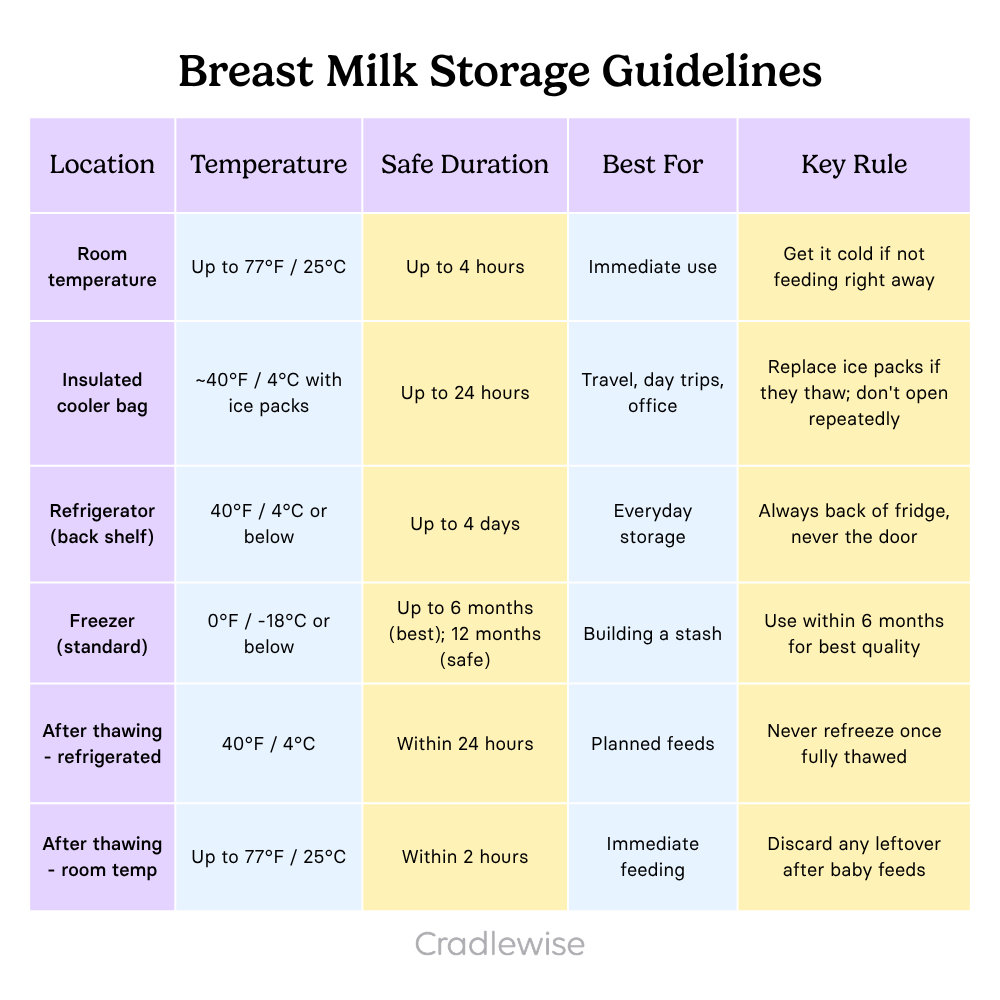
Sources: CDC Breast Milk Storage and Preparation, Academy of Breastfeeding Medicine Protocol #8, and AAP HealthyChildren.org
How long can breast milk be stored in the fridge
Your fridge keeps freshly expressed milk safe for up to 4 days without any of the nutrient changes that come with freezing.
- Temperature: your fridge must be at or below 40°F (4°C). If it doesn’t display temperature, a small digital freezer thermometer is worth having.
- Location: always the back shelf, never the door. The door is the warmest spot in the fridge and the most temperature-variable.
- The 4-hour room temperature rule applies to refrigerated milk too. Once refrigerated milk has been out at room temperature, use it within 2 hours or return it to the fridge promptly.
- Colostrum storing: “Colostrum is good in the fridge for 4 days, similar to mature milk,” says Aarani Montanari. When harvesting colostrum prenatally, moms can combine their colostrum from 4 days in a syringe or silicone colostrum collector and then move the colostrum to the freezer.
One question that often comes up during late-night feeds is how long refrigerated milk can safely sit out.
How long can refrigerated breast milk sit out
Once refrigerated breast milk has been taken out of the fridge, the CDC recommends using it within two hours. This is the safest guideline to follow, particularly for premature babies, babies under two months old, or babies with weakened immune systems.
Some lactation consultants find that parents of healthy, full-term babies may occasionally use a longer window, but the two-hour recommendation should remain the default.
For late-night pumping, Tamari Jacob suggests keeping a small mini-fridge nearby so milk can be chilled promptly.
Storing breast milk in the freezer
Freezing extends the life of expressed milk from 4 days to up to 12 months.
- Best quality: within 6 months.
- Still safe: up to 12 months at 0°F (-18°C). Quality may have declined but it’s not harmful.
- Location: back of the freezer, not in the door or in the ice-maker compartment.
- After thawing: use within 24 hours if refrigerated, or within 2 hours at room temperature.
For the full guide to freezing technique, stash-building, freezer organization, nutrient changes, and thawing, read our complete guide to how to freeze breast milk safely.
How to use a cooler bag for breast milk
A cooler bag with frozen ice packs keeps expressed milk safe for up to 24 hours, long enough for a full work day, a long journey, or a travel day with a connection.
- Ice packs must stay frozen. Once they thaw, the clock on your milk changes. Replace ice packs when they become soft.
- Don’t open the bag repeatedly. Every time you open it, cold air escapes and the internal temperature rises.
- At the destination: Refrigerate or freeze as soon as you arrive. If you’re heading home after a work day, go straight home rather than running errands with milk in the bag.
How do you store breast milk for preemies
Breast milk storage may require extra care for premature babies, babies with weakened immune systems, or babies receiving care in the NICU. Tamari Jacob adds that with full-term babies, you can widen the window by an hour or two when giving stored milk, but you can never take that risk with a baby who is in the NICU or otherwise premature.
However, Joanna advises to be more vigilant and sterilize and sanitize all parts that touch milk. She says, “This can be done by using the dishwasher (check manufacturer’s instructions on safety), a microwave steamer bag, a designated bottle sterilizer or by boiling.”
A frequent 3 am question is about traveling with stored breast milk.
How can I store breast milk while traveling
Most parents have questions on traveling with breast milk. Here they are answered:
Traveling by car with breast milk
An insulated cooler bag with frozen ice packs is all you need for car travel. Keep it on the seat or floorboard where it won’t be in direct sun, and refrigerate or freeze on arrival.
You can also use ice if needed and ask restaurants for new ice as you travel to your destination. This keeps milk safe for 24 hours before feeding, refrigeration, or freezing.
Traveling by plane with breast milk
Note: Keep a copy of the TSA breast milk policy on your phone when flying, in case TSA officers are unaware of the specifics of the policy. Also, always check specific airline and airport policies when traveling out of the country, with breastmilk on a plane, as rules differ from country to country.
Shipping breast milk
Cradlewise Note: It might be worth checking the benefits with your company. Click to know more about Milk Stork and Save the Milk.
Your late night pumping might lead you to wonder about how to warm breast milk that has been refrigerated or frozen, especially in the night.
How to warm breast milk
“ The best way to warm breast milk, especially in the middle of the night, is to use a milk bottle or bag warmer. While you can certainly warm the milk by placing the bottle or bag in a bowl of warm water, it may take a long time, and overnight feedings should be as efficient as possible so everyone can get back to bed.”
The most important rule: no microwave, no stovetop. Both create hot spots that can burn your baby’s mouth and break down the antibodies and nutrients that make breast milk valuable.
What to look for in breast milk storage bags
The right bag preserves more of what you worked to pump. Fat clings to plastic surfaces, so fewer transfers means more nutrients for your baby.
Look for:
- BPA-free and BPS-free materials
- Pre-sterilised (check packaging)
- Double-seal zip closure that won’t leak when frozen flat
- Volume markers in oz and ml
- A write-on label area for date and time
- Compatibility with your pump (some bags attach directly to the flange)
Avoid:
- Disposable bottle liners
- Reusing storage bags
Some commonly used breast milk storage bag brands are:
Note: While we, at Cradlewise, do not endorse specific brands, this information could prove useful when you are looking for good quality, reliable storage bags.
Whether you can reuse breast milk storage bags is one of the questions that mothers say they have genuinely thought about at 3 am. Let’s see what our lactation expert has to say.
Can I reuse breast milk storage bags?
She adds, “There is potential for bacteria growth once the bag has been thawed and emptied, so the typical plastic milk storage bags should only be used once.”
Another middle-of-the-night concern is whether milk that looks separated or curdled has gone bad
How to tell if breast milk has gone bad
Separation is normal in stored breast milk, especially when the fat rises to the top. A gentle swirl should usually bring it back together. However,
Aarani Montanari also notes that if the milk is curdled or if it smells rancid, it is most likely spoiled.
What are common mistakes in breast milk storage?
“The most common storage mistake I see parents make is putting leftover milk back in the fridge from a bottle feeding that baby did not finish,” says Aarani.
Once your baby has started drinking from the bottle, bacteria from their mouth enter the milk. The milk must be tossed after 2 hours if your baby doesn’t finish their bottle.
Joanna adds, “Creating too big of a stash, putting too much in storage containers, and not storing the milk in the back of the refrigerator.”
Conclusion
Breast milk storage can feel complicated and daunting, especially for first time parents. There are so many hacks and do’s and don’ts that it can be difficult to know which ones are actually safe.
A good rule of thumb is: When in doubt, always refer back to the CDC guidelines for breast milk storage since these are the most conservative.
Furthermore, if you follow the Rule of 4s, have the right breast milk storage bags, and label consistently, your milk will be safe for your baby to consume.
FAQs
Q: Can I reuse breast milk storage bags?
A: No, you should not reuse breast milk storage bags. Once the bag has been thawed and emptied, it could lead to bacterial growth. So, the typical plastic milk storage bags should only be used once.
Q: How to tell if breast milk has gone bad?
A: If the chunks in the breast milk do not dissolve back into the milk when you swirl the container, that is not fat and should be thrown out. Also, the milk may be spoiled if it smells rancid or sour, or looks curdled.
Q: How to store breast milk to bring to NICU?
A: Use gel or other freezer packs and an insulated cooler bag for transporting breast milk to the hospital. However, always follow the instructions provided by your baby’s medical team, as individual hospitals may have their own rules for containers, labels, transport, and refrigeration.
Q: How long is colostrum good in the fridge?
A: Colostrum is good in the fridge for 4 days, similar to mature milk. It lasts for the same period of time in the freezer too.
Q: Can I put leftover breast milk back in the fridge?
A: Yes, but only if it is untouched. If your baby has already drunk from the bottle, it cannot be put back in the fridge. It needs to be used within 2 hours or discarded.
You may also like:
- Finding your rhythm: How long should a newborn breastfeed at each session?
- Ask the expert — Cluster feeding: How to tell if your baby’s really hungry.
- Can formula go bad? How to spot the signs and keep your baby safe.
Sources:
- Never refreeze once fully thawed. CDC. 2026. Breast Milk Storage and Preparation.
- CDC Guidelines for breast milk storage. CDC. 2026. Breast Milk Storage and Preparation.