

Somewhere in the second trimester, there’s a moment somewhere when you pause, hand on belly, wondering: was that the baby? Or just breakfast? For many people, those first fetal movements are so subtle and unfamiliar they genuinely don’t know what they’re feeling.
Fetal movement from those first fluttery sensations to the unmistakable third-trimester kicks is one of the most reassuring parts of pregnancy. It tells you your baby is active and growing. It also becomes a way to connect with your baby and to gauge your baby’s wellbeing as the weeks go on.
This guide covers when do babies start kicking, what they feel like at different stages, how to track them, and what to do if something seems off.
We also spoke to Dr. Stanislaw Miaskowski, MD, OB/GYN at Orlando Health Winnie Palmer Hospital for Women and Babies, who has answered to some of the most common and most anxious questions parents have about their baby’s kicks in the womb.
Why are fetal movements important?
Fetal movement is one of the first signs that indicates your baby is alright and doing well inside your womb. When your baby moves, it shows that their central nervous system, muscles, and oxygen supply are working as they should. And changes in that pattern can be an early sign that something needs attention.
However, every quiet patch doesn’t mean something is wrong. Your baby’s sleep cycles, your own activity level, and where your placenta sits all affect what you feel. But understanding what your baby’s normal kicking looks like makes it easier to notice when something has changed.
When do babies start kicking?
Babies actually begin moving long before their parents can feel it, as early as 7 to 8 weeks, though these early movements are far too faint to detect without ultrasound. You can feel your baby’s kicks only when your baby is big and strong enough for those movements to register from the outside.
As per, the American Pregnancy Association (APA), if it is your second or subsequent pregnancy, you may feel the movements as early as 18 weeks because you already know what to look for. With a first pregnancy, feeling those sensations somewhere between 20 and 25 weeks is entirely normal. If you haven’t felt anything by 24 weeks, it is worth visiting your provider for a check.
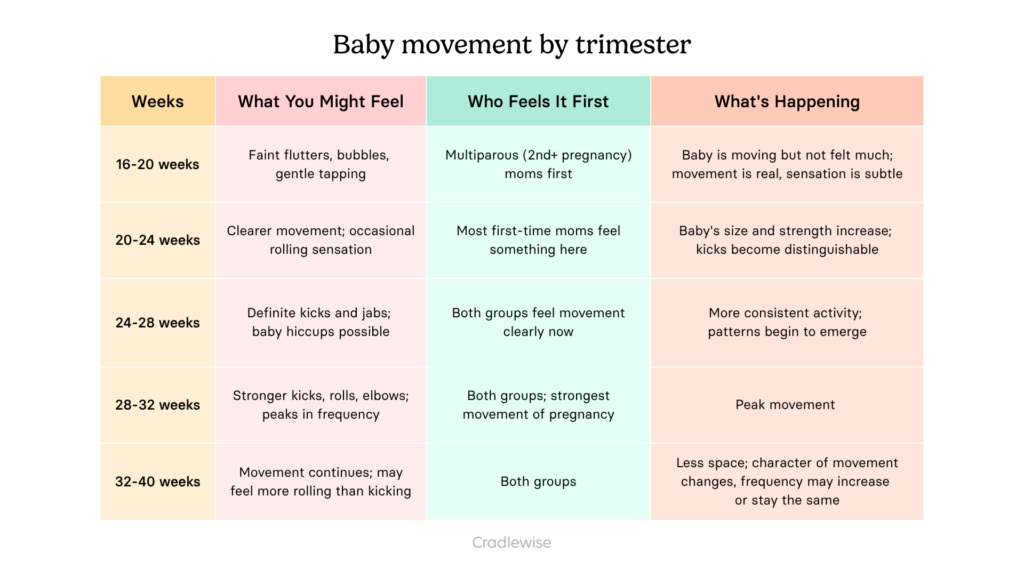
Source: Journal of Obstetrics and Gynaecology, NCBI StatPearls, and American Pregnancy Association
What will baby’s movements feel like?
Your baby’s movements feel like trapped gas or intestinal activity in the initial days, but as your pregnancy progresses, you can feel your baby’s strong kicks.
What will baby’s movements feel like in second trimester (18-24 weeks)
Early fetal movement is often mistaken for gas, digestion, or a muscle twitch. Most people describe the sensation as:
- A fluttering, like a butterfly inside the belly
- A gentle bubbling or fizzing sensation
- Light tapping or a rolling feeling
It’s soft and brief, hence most pregnant people fail to register it or dismiss it as nothing. The fact that it can feel exactly like gas is one of the reasons first-time pregnancies often take longer to identify. People who have had multiple pregnancies know what they’re feeling because they’ve felt it before.
What will baby’s movements feel like in third trimester (24 weeks onwards)
As your baby grows, their movements become unmistakable. By the third trimester, you’ll feel kicks, jabs, elbows, and full body rolls, some strong enough to make you catch your breath. Hiccups also become noticeable: a rhythmic, repetitive tapping that’s distinct from kicking.

Did you know?
Fetal movement frequency increases until around 32 weeks of pregnancy, after which 90% of women experience either an increase or no change in frequency till the onset of labor.
Where do you feel baby kicks?
Where you feel movement depends largely on your baby’s position and where your placenta sits. Early kicks are often felt low in the abdomen, sometimes described as pressure or fluttering just above the pubic bone. As your pregnancy progresses, the movement spreads upward and you’ll feel it across a wider area of the belly.
If you have an anterior placenta, where the placenta sits at the front of the uterus between the baby and your skin, it acts as a cushion that muffles movement. Kicks will still be there, but you may just feel them less strongly and slightly later than average. This is not a cause for concern.
Do I need to count baby kicks?
“However,” Dr. Miaskowski adds, “guidelines do suggest that if decreased fetal movement is detected, the primary obstetrician should be contacted and an official assessment with a non-stress test or biophysical profile should be completed.”
The practical takeaway: The ACOG doesn’t advise against counting kicks, but their guidance has shifted. Instead of counting your baby’s kicks daily, they want you to become familiar with your baby’s typical movement patterns, their active and quieter times, so you can notice any change or decrease in the pattern.
Note that the APA recommends counting kicks for higher-risk pregnancies and for all pregnancies at 28 weeks.
How to count baby kicks?
- Lie on your left side, eat something, and minimise distractions
- Count kicks, flutters, swishes, and rolls; any movement counts
- The goal is 10 distinct movements within 2 hours
- Most parents feel 10 movements within 30 minutes. If you don’t reach 10 in 2 hours, contact your provider.
What are the reasons for decreased fetal movement?
“ The most common physiologic or benign reasons for decreased fetal movement include: sleep cycle lasting up to 75 minutes, time of day (less movement in the morning versus late at night), maternal activity or distraction, maternal position, medications, anterior placenta, higher BMI, and advanced maternal age over 35 years.”
In other words, a busy day, your placental position, advanced maternal age, or your baby simply being asleep can all reduce what you feel. A baby’s sleep cycle can last up to 75 minutes, so a quiet patch of that length is not, on its own, unusual.
However, Dr. Miaskowski assures, “70% of pregnancies that report decreased fetal movement proceed without complications after formal assessment.”
What to do when you feel reduced movement?
If you notice a significant decrease in your baby’s usual pattern, especially in the third trimester, don’t wait to see if it picks up on its own:
- Eat or drink something, then lie on your left side in a quiet room.
- Begin counting. If you feel 10 movements within 2 hours, your baby is most likely fine.
- If you don’t reach 10 movements, or if you’re still concerned after counting, call your provider. They’ll either assess you in a clinic or send you for a non-stress test.
Cradlewise note: When in doubt, always call your primary obstetrician. Even if the formal assessment comes back normal, reaching out when something feels different is always the right thing to do.
When to call your doctor or midwife
Contact your provider promptly in these situations:
- You haven’t felt any movement by 24 weeks.
- There’s a significant decrease in your baby’s usual movement pattern that doesn’t improve after eating, lying down, and counting.
- Movement has completely stopped.
- You’re past 28 weeks and feel fewer than 10 movements in 2 hours.
Are at home fetal dopplers safe for babies?
“ At-home fetal dopplers are NOT a reliable way to assess fetal well-being and are discouraged by our professional societies. Detecting a fetal heartbeat only assesses a small moment in time and provides false reassurance and delay in appropriate evaluation. A formal assessment with a non-stress test or biophysical profile can predict a catastrophic event greater than 99% of the time.”
In other words, a beating heart is reassuring, but it doesn’t tell you what a non-stress test can. If you’re worried about movement, call your provider instead of relying on a doppler at home.
Conclusion
You are the most consistent monitor of your baby’s wellbeing throughout pregnancy. No test, app, or device knows your baby’s patterns the way you do. That’s worth taking seriously.
Those first flutters are one of the most memorable moments in pregnancy. And the more familiar you become with your baby’s movements over the coming weeks, the more confidence you’ll have in knowing when something is worth a call.
FAQs
Q: When will flutters turn into kicks?
A: Most people notice the shift from subtle flutters to definite kicks somewhere between 24 and 28 weeks. The timing varies by pregnancy, body type, and placenta placement; if you have an anterior placenta, you may feel the change slightly later.
Q: Do babies move less towards the end of pregnancy?
A: Yes, this is true for several factors. Dr. Stanislaw Miaskowski says it is because the fetus has less space at later gestations and also because the fetus develops the brain and consequently, has more organized motor coordination rather than random, sporadic fetal movement.
Q: Is it true I can make my baby move?
A: Eating or drinking something, lying on your left side, and minimising distractions may prompt your baby to move. But don’t rely on this as a substitute for contacting your provider. If your baby isn’t moving as usual, the right response is to count kicks and call if you don’t reach 10 movements in 2 hours.
Q: When can you see baby kick through the stomach?
A: Many parents first see their baby’s movement from the outside between 24 and 28 weeks, though this varies. It’s more visible later, especially in the third trimester, and when you’re lying down and relaxed. Partners and family members usually see the first kicks around week 28 or later.
Q: Is reduced fetal movement linked to stillbirth?
A: Yes. Dr. Stanislaw Miaskowski adds, “Reduced fetal movement is associated with an increased risk of stillbirth with an increased odds ratio of 2.9-4.51 and estimated stillbirth rate of 13 per 1000 episodes.” The baseline rate is 5-6 per 1000 births. This is why reduced movement is taken seriously by obstetric teams. If you notice a change, call your obstetrician.
You may also like:
- 15 Weird signs labor is near.
- What to do when labor starts: A stage-by-stage guide.
- Perineal massage during pregnancy: what it is, when to start, and does it really help?
Sources:
- Why are fetal movements important. NCBI StatPearls. 2026. Fetal Movement.
- When do babies start kicking. American Pregnancy Association. Counting Baby Kicks.
- Fetal movement frequency increases until around 32 weeks of pregnancy. BJOG. 2026. Reduced Fetal Movements Green-top Guideline No. 57.
- Counting kicks for higher-risk pregnancies. American Pregnancy Association. Counting Baby Kicks.


