You have booked the flights. You are genuinely excited. And then, somewhere between packing the nappy bag and downloading the boarding pass, the thought creeps in: how will I manage baby sleep while traveling?
It is one of the top most concerns new and even experienced parents have while traveling with a baby on summer vacation. Yes, your baby’s sleep will probably shift a little. New place, new light, new sounds; your baby notices all of it. But no, you will not undo months of good habits. And with a bit of preparation, the disruption can be surprisingly small. And you will manage just fine.
This guide covers what actually matters: what to pack, how to handle jet lag, how to navigate hotel sleep, and how to get back on track quickly when you are home.
We have also asked Dr. Jessica Hochman, a board-certified Pediatrician and Host of the podcast Your Child is Normal, and Arielle Greenleaf, the Founder/Owner and Pediatric Sleep Consultant at Expect to Sleep Again Consulting, to weigh in on the questions parents ask most.
Why is baby sleep while traveling stressful?
Three things are usually at play.
- Your baby’s body clock. Your baby’s circadian rhythm (sleep-wake rhythm) becomes established during the first 3 months. Also, an important point to note is that their circadian rhythm is regulated by light. When the light-dark cycle shifts, so does their internal timing.
- New environments register as novelty, and your baby’s brain is wired to notice novelty.
- Travel days tend to involve overstimulation, missed naps, and later evenings, which stack up quickly.
As the body’s internal clock becomes temporarily out of sync due to jet lag, Dr. Hochman warns, “It is common for infants to experience fragmented sleep, fussiness, feeding changes, or early waking.”
However, the good news, according to Dr. Hochman is, “Younger infants may actually adjust to time changes more quickly because their internal clocks are less rigidly established than an adult’s.”
In other words, though the disruption is real, your baby is more adaptable than you might think.
Pre-planning for baby sleep schedule on vacation
Hence, before you leave for your trip, these three things are worth doing.
Introduce the travel crib or portable crib at home
Set up the portable crib or pack ‘n play at least a week before you go and use it for three to five naps. A familiar sleep surface in a new room is far more settling than an unfamiliar one. This single step makes the first night away significantly smoother.
Shift the schedule gradually while traveling across time zones
For trips crossing two or more time zones, move nap and bedtime 15 to 30 minutes in the direction of your destination each day, starting three to five days before departure. You will not close the whole gap, but even an hour’s shift before travel meaningfully shortens recovery time at the other end.
However, Dr. Hochman is not too positive about shifting bedtime before travel. She finds this advice hard to do in actuality.
Cradlewise Note: There is no harm in adjusting your baby’s bedtime before travel. If it works, you have hit the jackpot. If it doesn’t, our tips below might help your baby sleep while traveling.
Pack familiar sleep cues, not new ones
Your baby does not need new gear. They need the same, familiar gear, in a new place. The smell of familiar crib sheets from home can work wonders in helping your baby adjust and feel secure in a new environment.
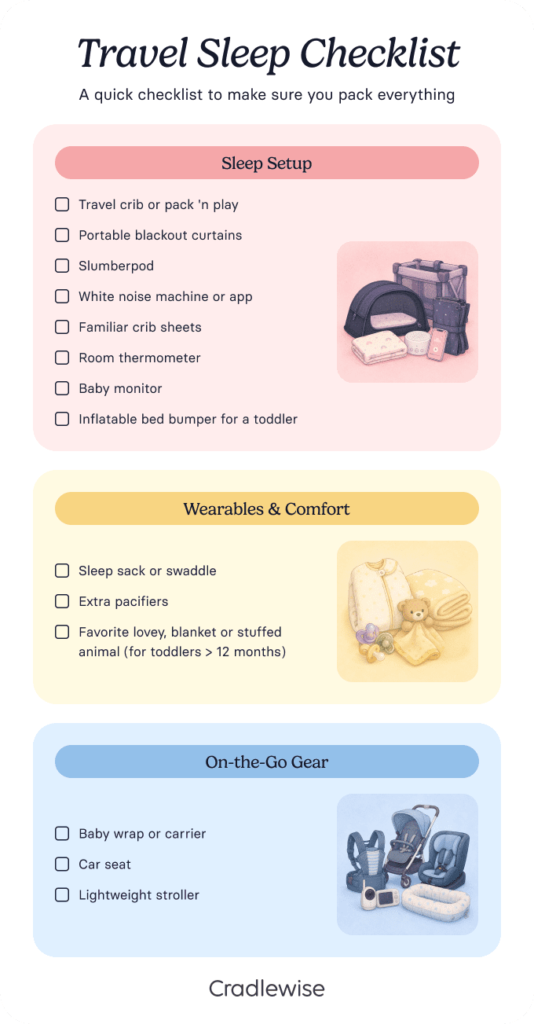
The table below is your packing checklist.
Travel Sleep Checklist
Pin it! Print it! With this baby travel sleep checklist, you and your baby are all set to go!!
Baby sleep in a hotel room
Hotel rooms are designed for adults, not babies. The light comes in at the wrong times, the sounds are unfamiliar, and you are probably sharing the space. Here is how to make it work.
- Set up the sleep space first. Before anything else. Blackout curtains up, sound machine on, familiar sheet in the crib, and comfortable sleep sack, swaddle, or wearable blanket. Having the space ready from the first nap rather than assembled at 8pm changes everything.
- Keep the bedtime routine exactly the same. Same steps, same order, same timing. Your routine is the most portable sleep tool you own. It signals sleep in a Balinese villa or Swiss chalet just as reliably as it does at home.
- Once your baby is down, go dark. Move screens, lights, and conversation to the bathroom or balcony. White noise protects your baby from your movements as much as from corridor sounds.
- Own the schedule from day one. Rather than trying to hold your home schedule, switch to local time on arrival. Short-term adjustment is less disruptive than a prolonged half-and-half approach.
Handling baby jet lag
Baby jet lag is the part parents fear most. Here is what actually helps and what does not.
The single most powerful tool available to you is free and requires no planning: Morning sunlight.
Arielle Greenleaf adds, “Even 30 minutes is helpful. And importantly, baby does not need to have direct sunlight on them — even sitting in the shade outside is more effective than indoor lighting.”
Can I give melatonin to my baby while traveling?
Cradlewise Note: According to HealthyChildren by American Academy of Pediatrics, some melatonin supplements have been known to contain serotonin and cannabidiol (CBD). Talk to your pediatrician before giving melatonin to your baby for travel. Also consult them about the proper dosage and timing of melatonin.
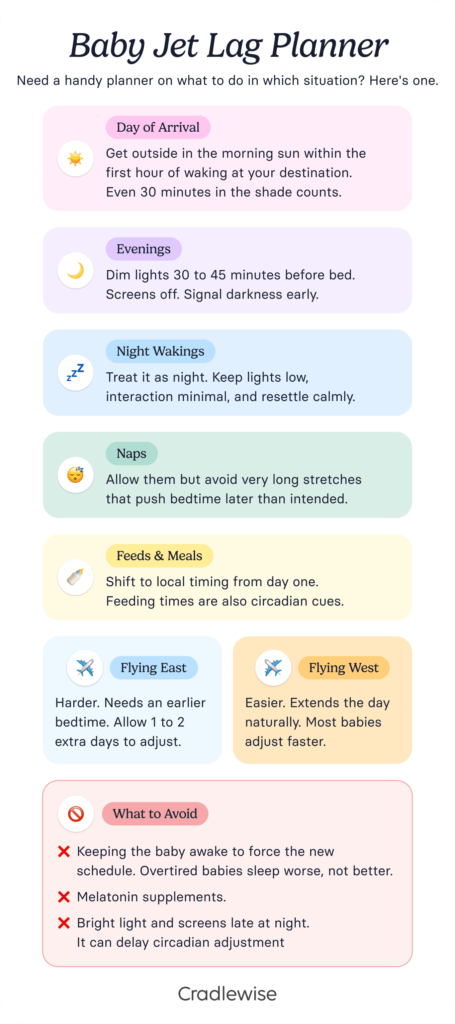
The table below is your baby sleep while traveling survival planner.
Need a handy planner on what to do in which situation? Here’s one
Baby sleep schedule on flights and travel days
Travel days will not be perfect sleep days. That is fine. The goal is to survive the journey keeping your baby as rested and comfortable as possible, not to maintain the schedule to the minute.
- Time your departure around naps where you can. Leaving during a natural nap window means the first stretch of travel is already covered.
- Car seats are for transport only. Car seats are comfortable and convenient on the move. But, they are not a replacement for a firm, flat cot. As per safe sleep guidelines for babies, if your baby falls asleep in the car, move them to a proper sleeping surface as soon as you reach your destination.
- If you are flying, earlier is better. An early arrival gives you the whole day to start adjusting to local light exposure before bedtime. To learn tips for flying with a baby, read this.
- Bring on-the-go sleep aids. Carry a tried and tested baby carrier or use the stroller’s canopy to help your little one nap comfortably on-the-go, in sun or shade.
- Bring the sound machine and crib sheet in your carry-on. Not the checked bag. These are non-negotiable for any sleep on the plane or at the destination on night one. Also, it will prove its weight in gold, especially if you are traveling for the fourth of July holiday and expecting fireworks.
- Forget the schedule on travel day itself. Focus on keeping your baby fed, rested however they can be, and not overtired at arrival. The schedule resumes at destination, not mid-airport.
- Expect adjustments. Don’t stress if naps run short or bedtime is 30-45 minutes later than usual.
Staying with family
This one is logistically trickier because you have less control over the sleep environment and more social pressure to be flexible. A few things that genuinely help:
- Communicate your baby’s sleep routine before you arrive. One conversation prevents five difficult ones.
- Identify the quietest room in the house on arrival day and set up the sleep space immediately.
- Give yourself permission to leave the dinner table or the evening gathering when wake windows demand it. Your baby’s sleep is what makes the visit enjoyable for everyone.
- If the environment cannot be properly darkened, a travel blackout pod over the crib is worth its weight in uninterrupted nights. Babies calm down quicker since they can’t see much around them and focus on sleeping.
Getting back on track when you are home
Good news: Most babies return to their pre-trip baseline within two to three days of consistent home routine.
- First night home: Put your baby down at their normal home bedtime. Do not try to ‘catch up’ lost sleep with an earlier bedtime as it usually backfires.
- First morning: Wake at the normal home wake time and get outside in the morning light. This is the fastest circadian reset available to you at home as much as it is abroad.
- Hold the routine for three days: Same routine, same schedule, same response to night wakings. Three consistent days is almost always enough.
- If holiday habits crept in: Address them gently after the first week home, once your baby is fully rested. Trying to fix everything on night one after a long trip rarely ends well.
Cradlewise Note: Summer vacations are temporary. Your baby’s sleep foundations do not disappear while traveling. They come back quickly with consistency.
Conclusion
Your baby is more adaptable than your anxiety makes them seem. A week away is not going to undo the months of routine you have built. What it will do is shift things temporarily, and with a familiar sleeping environment, consistent cues, and morning sunshine, those things shift back quickly.
Pack the sound machine. Get outside in the morning sunshine. Keep the bedtime routine the same wherever you are. And let yourself enjoy the holiday you have worked hard for.
Bon voyage ! And bon sommeil !
FAQs
Q: How long does baby jet lag last?
A: “Babies typically take about one day per hour of time difference to adjust. A one-hour difference resolves in a day; a six-hour overseas trip can take up to six days,” says Arielle Greenleaf. Most parents see meaningful improvement by nights three and four.
Q: What is the best way to reset a baby's body clock after travel?
A: Get your baby outside in the morning according to the new local time zone to help them adjust to time differences. Likewise, if it’s nearing nighttime, keep things dark and dim lights. Sleep is controlled by our exposure to light and darkness, so this absolutely speeds things up.
Q: Should I keep my baby on home time or switch to local time when we arrive?
A: Switch to local time on arrival. Trying to maintain home time alongside local time creates a prolonged half-and-half state that extends the adjustment period. Sync to local time on day one, anchor with morning light, and most babies adjust within a few days.
Q: What should I do if my baby wakes in the middle of the night due to jet lag?
A: Treat it as night. Keep lights low, interaction brief and calm, and resettle as you would at home. Avoid bringing them into bed if that is not your normal approach, as habits formed on holiday can be harder to undo than the jet lag itself.
Q: Will travel undo my baby's sleep routine?
A: No. Sleep foundations do not disappear during a trip. Some disruption during travel is completely normal, and most babies return to their home routine within two to three days of consistent cues and schedule after returning. The key is reinstating the home routine firmly on the first night back.
Q: Do I give direct sunlight to my baby to adjust to a new time zone?
A: Yes. 30 minutes of outdoor morning light exposure during the first few days after arrival helps in adjusting to changed time zones. Your baby does not need to have direct sunlight on them. Even sitting in the shade outside is more effective than using indoor lighting.
You may also like:
- Is your baby a Velcro baby? What it means and how to make things easier.
- How to get your toddler to sleep in their own bed (without bedtime battles).
- What is revenge bedtime procrastination and why is it so alluring to parents?
Sources:
- Why is baby sleep while traveling stressful? ScienceDirect. 2002. The development of infants’ circadian rest–activity rhythm and mothers’ rhythm.
- Can I give melatonin to my baby while traveling? HealthyChildren. 2026. Melatonin for Kids: What Parents Should Know About This Sleep Aid.