C-section recovery is a journey that looks different for every parent, but knowing what to expect can make it feel a lot more manageable. Whether your cesarean was planned or unexpected, your body needs time to heal from both major abdominal surgery and childbirth.
In the first few weeks, even simple movements such as getting out of bed, standing up, or lifting your baby can feel challenging. It’s completely normal to need extra support as your body heals and regains strength.
In this guide, we combine insights from Stanislaw Miaskowski, MD, OB/GYN, from Orlando Health-Orlando Regional Medical Center, and Erica Manto Paulson, Certified Doula, Childbirth Educator & the founder of Nurture in Cincinnati, Ohio, to walk you through the C-section recovery timeline, what’s normal, what’s not, and how to support your healing, physically and emotionally, step by step.
What is a C-section?
A C-section, or cesarean section, is a surgical procedure used to deliver a baby through incisions made in the mother’s abdomen and uterus. It may be planned or performed during labor if complications arise that make vaginal delivery unsafe.
A horizontal incision is made just below your bikini line that will measure approximately 10 to 20 centimeters long. The entire procedure usually takes about 45 minutes.

Did you know?
In 2024, 32.4% of live births in the U.S. were cesarean deliveries.
How long do you stay in recovery after C section?
Immediately after a cesarean section, most women typically stay in the post-operative area for 2-3 hours. Here, the vital signs are monitored and early skin-to-skin and feeding can begin if both mom and baby are stable.
The hospital stay is usually for 1-2 days post surgery. However, you may be required to stay an extra day or two in case your healthcare provider feels the maternal postpartum recovery and infant transition milestones are not being met.
C-section recovery timeline: What to expect in c-section recovery week by week
C-section recovery typically takes about 6 to 8 weeks, but healing happens in stages. While you may start feeling better within a few weeks, full internal healing takes longer.
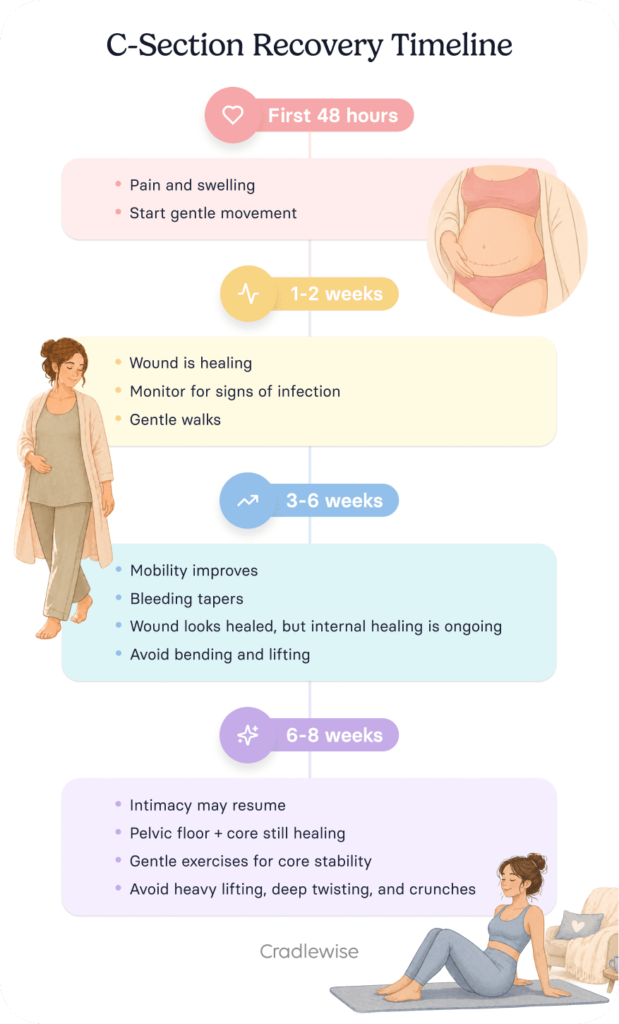
First 24-48 hours after a C-section
- It is common to experience pain, swelling, and fatigue, and find it difficult to sit up, stand, or bend.
- You can usually begin eating within a few hours (usually after 8 hours), especially if you’re breastfeeding.
- You will be encouraged to start gentle movement within 6–12 hours, like sitting up or taking a few steps, to support recovery.
- The urinary catheter is typically removed within 12 hours once you can move safely without feeling dizzy.
- Your care team will provide safe and effective pain relief to keep you comfortable.
- You will be supported in starting breastfeeding or expressing milk early, which helps build supply and prevent discomfort from breast engorgement.
Weeks 1-5 after C-section
By this stage, you are usually home and gradually settling into a routine. Pain will gradually reduce, but you may still experience tenderness.
- You will experience contractions after delivery that may be painful, as your uterus is shrinking to its normal size. They are also called afterpains, and are more common during breastfeeding.
- It’s important to follow up with your OB-GYN within 1–2 weeks to check your recovery and incision healing.
- Your doctor will advise when to remove your wound dressing, as timing can vary depending on the type used.
- The C-section scar begins to heal externally, though internal healing is ongoing.
- You may start moving more comfortably, but bending and lifting are still limited.
- You will experience vaginal bleeding for up to 6 weeks in the form of blood clots first, and then as a yellowish vaginal discharge.
Weeks 6-8 postpartum
You will find your strength returning, though you still have a long way to go.
- Your incision is mostly healed, though your scar may still feel sensitive.
- You may be cleared for normal activities and light exercise like lifting light weights, walking, running, and targeted muscle therapy.
- You can slowly return to routines, depending on your doctor’s advice.
Beyond 8 weeks postpartum
Recovery is significantly easier when parents have support so they can focus on rest, healing, and bonding with their baby.
- Your internal healing continues for several months post-cesarean surgery.
- The appearance of your scar may keep changing over time.
- Strength and core recovery improve gradually.
How long do you stay in recovery after C-section?
C-section recovery doesn’t happen all at once. It’s a gradual process that can take 6 to 8 weeks for initial healing, with full recovery taking a few months as your body regains strength.
How to manage C-section pain
C-section pain is usually most intense in the first few days and gradually improves over 2–3 weeks, though mild soreness or sensitivity around the incision can last longer.
Erica Manto Paulson says, “Pain is typically managed through a combination of prescribed medications and over-the-counter pain relief. Many parents find that taking pain medication on a consistent schedule—rather than waiting until pain becomes severe—helps recovery feel much more manageable.”
Dr. Miaskowski suggests early mobilization and a combination of muscle-targeted therapy, including pelvic physical therapy and certain exercises, ice and heat therapy as needed, a well-balanced diet, and adequate sleep hygiene for pain management.
How long does it take a C-section scar to heal
The outer C-section scar typically heals within 4-6 weeks, but deeper internal healing can take up to 8-12 weeks or more.
At first, the scar may appear pink or darker in color, but it should fade in a few months. There is a chance that your scar becomes raised and red, especially if you are of African or Middle-Eastern descent.
C-section bleeding
Vaginal bleeding (lochia) can last for 4-6 weeks after a C-section, starting heavier and gradually becoming lighter and watery over time. Sometimes you may experience vaginal bleeding upto 8 weeks. It starts with bright red, then turns dark red. Over time, it turns pink or brown, and usually turns yellow or white until it stops.
Remember: Use only sanitary pads. Avoid using tampons to prevent infection.
Your life after C-section involves more than pain management and scar healing. Learn how to sleep, feed, and exercise after surgery.
Tips for C-section recovery
Recovering from a C-section takes time, but small, intentional steps each day can help your body heal more comfortably and reduce the risk of complications.
1. Start gentle movement early
Research shows the risk of blood clots is up to 4 times higher after a cesarean birth compared to vaginal birth.
Light movement like short walks (even for a few minutes around your room) and managing small chores in the house helps improve circulation and reduce the risk of complications like deep vein thrombosis.
2. Take rest seriously (even when it’s hard)
Your body is healing from major surgery. Even short periods of rest throughout the day can support healing and reduce strain on your incision.
3. Care for your incision daily
Did you know?
Infection-related wound complications were the second most common factor for postpartum readmission, accounting for 15.5% of all readmissions, in a study done on more than 8 million deliveries in the USA.
- Clean the incision daily with mild soap and water and pat it dry.
- Do not use hydrogen peroxide or rubbing alcohol.
- Avoid applying any lotions, powders, or oils to your c-section incision or even the area around it.
- Watch for signs of infection like redness, swelling, or discharge.
4. Support your body during movement
These small adjustments reduce pressure on your incision and make movement more manageable.
- Use the “log roll” method to get out of bed without straining your core.
- Support the incision with a small pillow when coughing, laughing, or changing positions.
- Support garments like abdominal binders may offer additional support and help reduce discomfort.
5. Manage pain proactively
Pain is expected, especially in the first few days. Take doctor-approved pain relief regularly instead of waiting for pain to worsen. Take comfort from ice and heat therapy as you feel fit.
6. Ask for help and accept support
Getting help with chores, meals, and baby care allows your body to heal properly.
- Hire a postpartum doula.
- Ask your friends and family to help you with specific tasks.
- Consider a meal delivery service.
- Look into outsourcing laundry.
7. Don’t ignore your emotional recovery
Emotional well-being is an important part of over-all C-section recovery. According to the Centers for Disease Control and Prevention, about 1 in 8 women experience postpartum depression.
- Mood swings and “baby blues” are common in the first two weeks.
- Seek support if feelings of sadness or anxiety persist.
When to call a doctor
Dr. Miaskowski suggests you look out for these warning signs:
- Heavy bleeding, soaking through more than one pad per hour for two hours or passage of large blood clots.
- Severe headache or persistent visual changes that do not improve with medications or rest.
- Chest pain or shortness of breath that is persistent.
Fever with a temperature greater than 100.4 F/38 C - Severe abdominal pain that is persistent and different than previously experienced incisional pain. Additionally, if it is not improving with medication or typical recovery measures.
- Wound concerns, including increasing redness, warmth, swelling, drainage, foul odor, or separation of the incision.
- High blood pressure with symptoms including headache, vision changes, upper abdominal pain, and increasing extremity swelling.
- Urinary symptoms, including inability to urinate, pain with urination, or foul-smelling discharge.
- Mental health concerns, including thoughts of harming yourself or the infant.
- Leg pain and swelling, which may indicate a blood clot.
- Change in consciousness or seizures.
Conclusion
C-section recovery is a gradual process that deserves patience, care, and support. While the first few weeks can feel physically demanding, each stage of healing brings small improvements that help you regain strength and confidence.
With guidance from your healthcare provider and the right support system, you can focus on healing while also bonding with your baby.
As every recovery journey is different, be patient, give yourself the time and care you need as you move through C-section recovery at your own pace.
FAQs
Q: When does the uterus shrink after a C-section?
A: The uterus starts shrinking immediately after delivery and typically returns to its pre-pregnancy size within 6-8 weeks, though you may feel cramping (afterpains) during this process.
Q: How many C-sections can you have?
A: There’s no fixed limit to how many C-sections you can have, but risks tend to increase with each surgery, including complications related to the placenta, scar tissue, and the uterus. Because every pregnancy is different, this decision should be made with your doctor, taking into account your health, risk factors, past deliveries, and future family plans.
Q: How long after C-section should I bleed?
A: Bleeding after a C-section (lochia) typically lasts 4-6 weeks, starting heavier and gradually becoming lighter, though some light spotting can continue a bit longer.
Q: How long does it take to feel normal after a C-section?
A: Most parents start feeling better around 6-8 weeks, but full recovery, especially internal healing and core strength, can take a few months.
Q: When can I lift my baby after a C-section?
A: You can safely lift your baby soon after surgery, but avoid lifting anything heavier than your baby for at least 4-6 weeks to protect your incision.
Q: Is it normal to feel numbness around the C-section scar?
A: Yes, numbness or tingling around the incision is common and can last for weeks or even months as nerves heal.
You may also like:
- Advice from a new mom, going into 2026
- The 4th trimester explained: What’s happening to your baby (and you)
- Self care awareness month: 10 micro-moments of peace for exhausted new parents
Sources:
- Incision. NHS UK. Recovery Ceasarean Section.
- Live births in the US. Vital Statistics Rapid Release. 2025. Births: Provisional Data for 2024.
- Blood clots after C-section. ScienceDaily. 2016. Cesarean section carries increased risk for postpartum venous thromboembolism (VTE).
- Incision care. American Journal of Obstetrics and Gynecology. 2026. Surgical site infections after cesarean delivery.
- Postpartum depression. CDC. 2024. Symptoms of Depression Among Women.