
As a parent watching your baby squirm in pain, grunt, pull their legs up, and struggling to sleep is painful.
Having a gassy baby is one of the most common complaints of parents in the first few months of their baby’s life, and it’s usually a normal part of a brand-new digestive system finding its footing. But seeing your little one uncomfortable and unable to rest peacefully is enough to make any parent feel helpless and frustrated.
That said, knowing what’s normal, what actually helps, and what to watch for can make those gassy evenings a lot less stressful. Here’s what you need to know.
We consulted medical experts on how to help gassy babies, and this is what we have learnt from them:
- Dr. Molly O’Shea, MD, FAAP, the Founder of Birmingham Pediatrics
- Dr. Savita Srivastava, Yale-trained gastroenterologist and microbiome specialist
- Dr. Kenneth Cruse, MD, Pediatrician at Manning Family Children’s Hospital
- Mindy Cockeram, Board Certified Lactation Consultant, Author, and Founder of learn4birth
What are signs of a gassy baby?
If your baby is gassy, they may show their discomfort through crying, fussiness, and restlessness. However, sometimes the signs can overlap with other causes of fussiness, hence it helps to know what to look for:
- Pulling legs up toward the belly: A classic sign of gas discomfort.
- Arching the back and squirming: Your baby is trying to find a position that relieves the pressure.
- Bloated or hard belly: If on gently pressing on your baby’s tummy, it feels drum-tight, gas may be trapped.
- Passing gas frequently or with effort: The squeamish face they make while working gas through is completely normal.
- Fussiness during or after feeds, then settling once they pass gas: Gas can make feeding challenging for babies. They may refuse feeding or have a decreased appetite.
- Difficulty sleeping, especially in the evening: They may cry more than usual and have difficulty calming down.
It’s important to note that these signs can also be associated with other factors, such as hunger, tiredness, or discomfort from other sources. If you suspect your baby is experiencing gas or if their symptoms persist or worsen, consult with your pediatrician.
What causes gas in babies?
Beyond developmental immaturity, a few specific things make gas more likely in your baby:
- Swallowing air during feeds. As they’re learning to feed from the breast or the bottle, babies may sometimes swallow air; they may also sometimes swallow air while crying. This leads to gas, which babies release in two forms: burps or flatulence.
- Incorrect feeding technique. Fast flow from a nipple or shallow latch on the breast while feeding can cause babies to swallow air along with their milk, leading to gas.
- Overfeeding. A baby’s stomach is small. Feeding a baby too much, too quickly, or not burping them properly after feeding can affect their digestion and cause excess gas.
- An immature gut microbiome. The bacterial community in your baby’s gut is still establishing itself. Certain gas-producing bacteria are more common in early infancy and tend to reduce naturally over time.
- Gastrointestinal conditions. Gastroesophageal reflux (GER) and, less commonly, cow’s milk protein allergy (CMPA) can cause increased gas. See the ‘when to call a doctor’ section below for signs that point toward these.
- Introduction of solid foods. When solid foods are introduced, it can take time for the baby’s digestive system to adjust, leading to increased gas production.
- Food sensitivities or allergies: Some babies may have sensitivities or allergies to certain foods, such as cow’s milk protein in formula or specific foods in the mother’s diet (if breastfeeding). This can cause digestive issues and gas. We talk about it in length later in the article.
Reflux is a common condition in infants where milk travels from the stomach into the esophagus and results in spitting or vomiting. The acid that travels with the milk, creates pain in the esophagus. If an infant is spitting or vomiting excessively, treatment might need to be focused on reflux instead of gas. Parents should discuss feeding issues with their medical providers.
Why is my breastfed baby so gassy?
One of the most persistent myths in breastfeeding is that eating broccoli or cabbage will make your baby gassy. Dr. Srivastava addresses this directly:
If you suspect a dietary trigger, a targeted 2-4 week elimination of dairy, not a complete diet overhaul, is the recommended approach.
Dr. Srivastava cautions against broad elimination diets: removing too many foods changes the diversity of the parent’s own microbiome, which in turn affects what gets passed along in breast milk. Your baby ends up missing critical microbes from breast milk and may have chances of developing atopic diseases like food allergies, allergic rhinitis, eczema, and asthma later in life.
Mindy Cockeram agrees, “I recommend eliminating it from the maternal diet for 5 days to see if there is any change. If not, I encourage adding it back in slowly.”
Why is my formula-fed baby so gassy?
For formula-fed babies, the formula itself is rarely the direct cause. The more common culprit is bottle-feeding technique (fast flow, incorrect angle, swallowing air). That said, if gas is persistent and severe, you can try these options:
- Lactose-free formula: Dr. Kenneth Cruse says, “Milk has a sugar called lactose and some infants cannot tolerate the gas produced when it is digested. Changing the milk to a lactose free formula would bypass this step of digestion and can lead to improved infant digestion.”
If there is no improvement with lactose free milk, then a milk protein allergy should be considered for which Dr. Srivastava has the following solutions:
- Hydrolyzed formulas: The milk proteins are pre-broken into smaller, easier-to-digest pieces, reducing the workload on your baby’s immature gut. Worth trying if the standard formula seems to be causing distress.
- HMO or GOS-supplemented formulas: These prebiotics help feed beneficial gut microbes like Bifidobacterium infantis, which naturally reduces gas-producing bacteria. Look for formulas listing HMOs (human milk oligosaccharides) or GOS (galacto-oligosaccharides) on the label.
Mindy Cockeram adds that non-bovine (non-cow’s milk) formulas may also be easier for some babies to digest.
Cradlewise Note: Always discuss a formula switch with your pediatrician rather than trialling several brands in quick succession.
How to help gassy baby?
The most effective techniques to help your baby relieve gas are the oldest ones; hands-on, movement-based, and genuinely soothing for both baby and parent.
- Burp frequently: After each feed and when switching breasts or during bottle feeding. Hold your baby against your shoulder, across your lap, or upright on your thigh, leaning slightly forward, and gently pat or rub their back.
- Bicycle legs: Lay your baby on their back and gently move their legs in a bicycling motion as if they’re riding a bike. This movement helps push trapped gas through the intestines.
- Tummy massage: With your baby on their back, make gentle clockwise circles around the navel with your fingertips. Follow the direction of the digestive tract.
- Tummy time. The pressure of lying on their belly helps release gas. However, keep in mind tummy time must always be supervised, always when your baby is awake and alert.
- Keep them upright after feeding. Hold your baby upright for 20–30 minutes after a feed before laying them down. If your baby is older than 4 months and has control and balance in their head and neck, you could also try laying your baby on their back and then gently pulling them upwards by the arms. This lets gravity help digestion and reduces gas buildup.
- Slow down feeding: If your baby is bottle-fed, consider using a slower-flow nipple or paced feeding technique. If you’re are breastfeeding mother, express your milk a few minutes before nursing. Since the flow of your breast milk is fastest at letdown, this will slow down the flow when your baby feeds.
- Avoid overfeeding: Feeding your baby smaller, more frequent meals instead of larger ones can help prevent gas buildup. Pay attention to their fullness cues, such as turning their head away or slowing down their sucking.
- Hold in a football clutch: Cradling your baby face-down along your forearm, applies gentle pressure to the belly and is often remarkably effective for gassy discomfort. It’s also a great position for dads and non-feeding partners to use to help soothe and bond.
Do gas drops or gripe water actually work?
“ Both options are worth trying, provided you use them safely. Start with simethicone drops first since they are chemically inert and can be used from day one. If you decide to try gripe water later, just read the label: choose a reputable, alcohol-free, sodium bicarbonate-free, and sugar-free brand, and introduce it slowly.”
Dr. O’Shea agrees gas drops are safe and worth trying. However, Mindy Cockeram is more measured in her opinion, “There is no solid evidence to support the use of simethicone or gripe water. Still, there appears to be no unfavorable downside.”
Cradlewise Tip: If you want to try them, start with simethicone (gas drops) as they’re safe from birth. Wait until at least one month for gripe water, and read labels carefully as gripe water is highly unregulated and may contain allergens, contaminants, or sodium bicarbonate which can disrupt the pH balance in your baby’s delicate gut.
Do probiotics help gassy babies?
This is where the science is genuinely interesting, but specificity matters enormously.
Dr. Srivastava also adds that several clinical trials have shown that L. reuteri DSM 17938 reduces crying and fussing times in breastfed infants with colic, often by over 50% within 21 days. Notably, the evidence is strongest for breastfed infants, because human milk oligosaccharides in breast milk help this specific strain colonize and thrive, while for formula-fed infants, the benefits are mixed or negligible.
Why is my baby more gassy at night?
If you have noticed your baby is more gassy as the evening sets in, you are not alone. There are a few reasons for this:
- Milk composition changes across the day. Evening milk tends to be higher in fat, which takes longer to digest.
- During the day, your baby can release gas by moving their body, but when they’re about to sleep at night, they’re more still, which restricts them from relieving gas.
- Babies swallow more air when they’re overtired or feeding more frantically at the end of the day.
- They’ve been swallowing air all day, and it accumulates.
Due to accumulation of gas, your baby might fuss and have difficulty sleeping.
Dr. O’Shea’s advice for helping gassy babies sleep is worth quoting:
On the question of a baby sleeping on tummy, Dr. O’Shea quotes:

Did you know?
The safest sleep position for babies is always on their back, on a flat, firm surface. It is one of the most evidence-supported SIDS prevention measures available.
To know more about Safe sleep for babies, read our parent-friendly guide.
Colic vs Gassy baby: How to tell the difference
Gas and colic often get confused because both involve a fussy, crying baby. The difference is in the pattern:
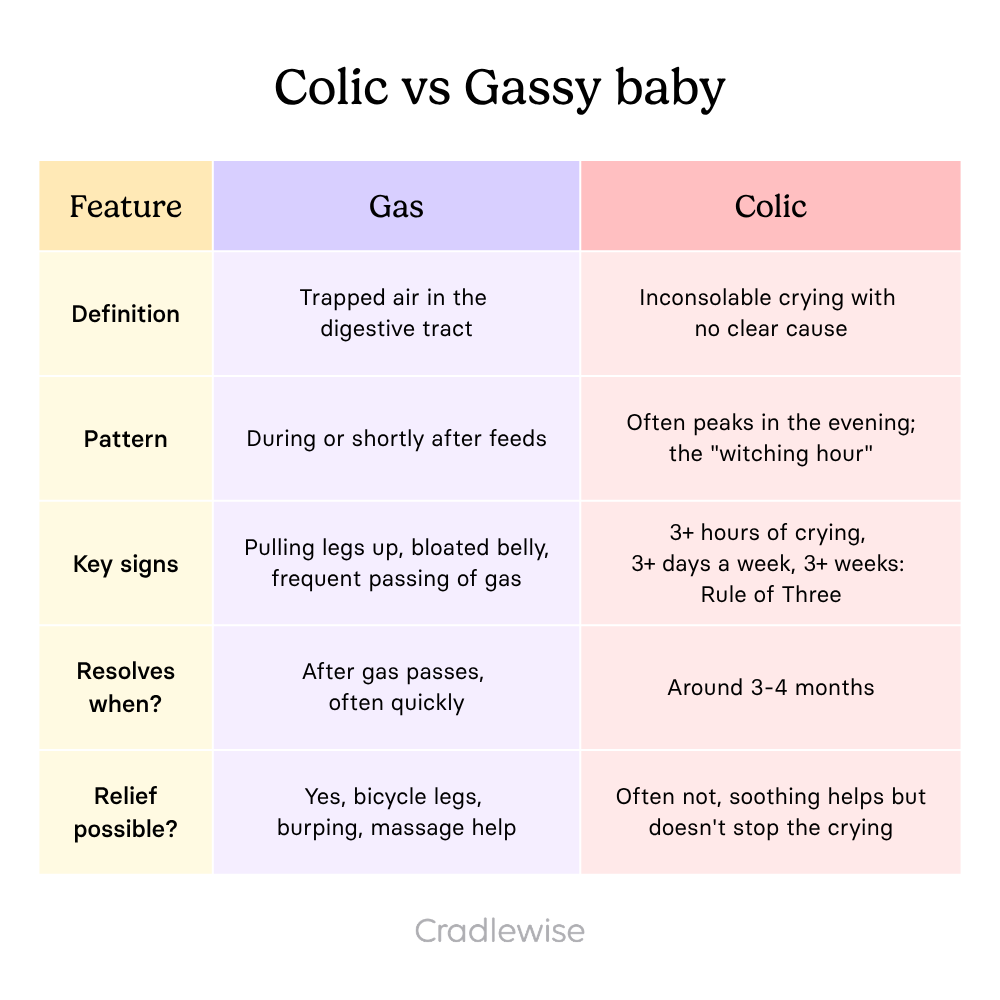
To know more about baby colic and how to soothe a colicky baby, read our parent-friendly, expert-backed guide.
How do I know if my baby has gas or acid reflux?
Sometimes, it’s neither gas nor colic your little one is experiencing. Dr. Kenneth Cruse sheds light on the matter:
“ Reflux is a common condition in infants where milk travels from the stomach into the esophagus and results in spitting or vomiting. The acid that travels with the milk, creates pain in the esophagus. If an infant is spitting or vomiting excessively, treatment might need to be focused on reflux instead of gas. Parents should discuss feeding issues with their medical providers.”
When to call your doctor
While infant gas is normal, these signs are not:
- Inconsolable crying for hours, multiple days a week. This may be colic, or something that needs evaluation.
- Violent or projectile vomiting.
- Blood or mucus in the stool. This can indicate cow’s milk protein allergy or another inflammatory issue.
- Fever or a clearly unwell baby.
- Poor weight gain or refusing feeds.
- Significant eczema alongside digestive symptoms. Combined gut and skin issues can point toward CMPA.
“ If they are crying inconsolably for hours a day, screaming in obvious pain, losing weight, spitting up violently, or if you see blood or mucus in their diaper — that is not just gas. That is a sign of inflammation or an underlying issue like a food allergy that absolutely needs a doctor’s evaluation.”
Mindy Cockeram adds, “As an IBCLC, we look at stool color, consistency and frequency. If the baby had persistent stool any other color than mustard, I’d see the pediatrician.”
Conclusion
Gassy babies are frustrating, exhausting, and genuinely hard to watch. But the vast majority of cases resolve on their own as the digestive systems mature, usually by 3-4 months. In the meantime, burping, bicycle legs, and staying calm are the most effective tools you have.
Also, comfort your baby. As Dr. Kenneth Cruse says, “When a baby is feeling pain, it is important to use human touch through cuddling, hugging, rocking and even singing to comfort crying infants. This decreases the suspected emotional pain they experience and is a strong form of bonding.”
Lastly, if something doesn’t feel right, trust your instincts and call your pediatrician. That’s always the right move.
FAQs
Q: How do I know if my baby is gassy?
A: Look for pulled-up legs, a bloated or hard belly, arching the back, and fussiness during or after feeds that settles once gas passes. If your baby passes gas and immediately calms down, it’s almost certainly just gas.
Q: Why is my baby gassy at night?
A: Evening milk is higher in fat and takes longer to digest, tired babies tend to swallow more air when feeding, and gas accumulates throughout the day. A calm, unhurried feeding environment in the evening can help reduce how much air your baby swallows.
Q: Is it gas or colic?
A: Gas is trapped air that causes discomfort but passes and your baby usually settles after releasing it. Colic is defined by the Rule of Three: crying for 3+ hours a day, 3+ days a week, for 3+ weeks, with no clear cause. Gas is a possible trigger of colic, but the two are not the same thing.
Q: Do gas drops help babies?
A: Simethicone gas drops are safe from birth and worth trying. They’re chemically inert and help break large gas bubbles into smaller ones that pass more easily.
Q: Does gripe water help with gas in babies?
A: Gripe water is an herbal remedy containing herbs like fennel, ginger, or chamomile, which are believed to soothe the digestive system. However, avoid giving gripe water until your baby is at least one month old and choose a reputable, alcohol-free, sodium bicarbonate-free, and sugar-free brand, and introduce it slowly.
Q: Can breastfeeding position or latch cause gas?
A: Yes, a shallow latch causes babies to swallow significantly more air with each feed, which is a direct contributor to gas. Mindy Cockeram, IBCLC, recommends checking latch and feeding position before assuming diet or formula is the issue. A lactation consultant can identify and correct latch problems quickly.
Q: What’s the best formula for gassy babies?
A: There’s no single magic formula as gas is rarely caused by an ingredient in the formula itself. Instead of standard formulas, try partially hydrolyzed or extensively hydrolyzed formulas (where proteins are pre-broken down) or formulas supplemented with HMOs or GOS prebiotics for a healthier gut microbiome. Always discuss formula changes with your pediatrician.
You may also like:
- PURPLE Crying: What It Is, Why It Happens, and How to Get Through It.
- Norovirus in children: When symptoms peak and when they finally stop.
- What roseola rash really looks like on baby skin (and why it’s often misdiagnosed).
Sources:
- Swallowing air during feeds. AAP. 2022. Why Babies Spit Up.
- To help your baby relieve gas. AAP. 2025. Gas Relief for Babies.
- Clinical trials related to probiotic L. reuteri DSM 17938. Acta Pediatr. 2023. Probiotics for infantile colic: Is there evidence beyond doubt? A meta-analysis and systematic review.
- Safest sleep position. AAP. 2022. Sleep-Related Infant Deaths: Updated 2022 Recommendations for Reducing Infant Deaths in the Sleep Environment.