
Most people hesitate to approach as they don’t know what to say to someone who had a miscarriage. If someone you love just lost a pregnancy, you’re probably here because you want to show up for them without getting it wrong or because you don’t know what to say to them.
There are times when words feel small and inadequate, and silence feels safer than saying the wrong thing. But for parents grieving a miscarriage, your silence can feel like their loss isn’t being acknowledged at all.
Miscarriage is far more common than most people realize. A study estimated that 26% of all pregnancies and up to 10% of confirmed pregnancies end in miscarriage.
But common doesn’t mean small, and also at what stage the loss took place doesn’t hold relevance either. A pregnancy loss is a loss of a baby for the parents, and no amount of time fully closes this particular loss.
What can help are kind words and small ways to show up for someone moving through this.
Cradlewise Note: If you are reading this after losing a pregnancy, we are deeply sorry for your loss. Whatever you’re feeling right now, in whatever order, is justified. There is no wrong way to grieve a child, and no timeline you’re required to follow. If you’d like support for parents after pregnancy loss, you’ll find grief support and resources further down this page.
What to say to someone who had a miscarriage
To be honest, there are no perfect words of comfort for miscarriage, and searching for them can be an added pressure you’d rather not carry.
What helps most is being simple, direct, and warm:
- I love you, and I’m here for you.
- I’m so sorry for your loss. I’ve been thinking about you and your baby.
- I don’t know what to say, but I’m not going anywhere.
- It’s okay to feel whatever you are feeling. Anger, hate, sadness, grief, or confusion – it’s all okay to feel it all.
What not to say after a miscarriage
Most hurtful comments come from people trying to help. It’s not that they don’t care, still they sometimes end up saying the wrong things:
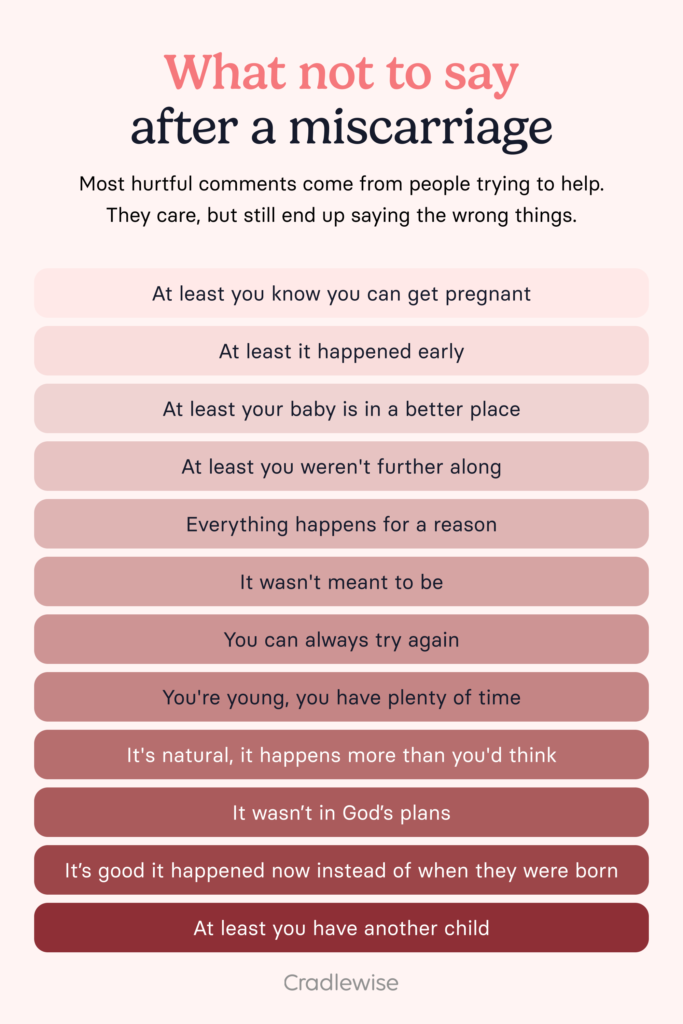
Each of these reaches for a silver lining and fails miserably. Every grieving parent knows all of this is true, but it doesn’t take away their pain. In fact, it can make them feel like their grief is being minimized, or that they should already be looking forward instead of grieving what’s happened.
Cradlewise Tip: If you’re ever unsure what to say, it’s safer to say less and mean it than to offer reasons that sound insincere.
How to comfort someone after a miscarriage
Words matter, but what matters more is showing up. A few things help:
- Offer practical and specific support. “Let me know if you need anything” is kind, but it puts the pressure of asking back on them. “I’m dropping off dinner Thursday, no need to talk if you’re not up for it” takes off that pressure. Or pick up groceries, run an errand, or take care of their household chores.
- Let them talk, or not talk, about it. Some people need to tell their story more than once. Others feel they are not up to it. Follow their lead.
- Listen. Some people grieve their loss by repeating their story. Just sit by their side and listen. Being patient can be one of the better ways you can support them.
- Acknowledge their baby. If you know the baby’s name, or the parents have shared how far along they were, use it. Hearing their baby acknowledged, by name carries more meaning than most words do.
- Sit through their fear. If they say they’re scared this will happen again, they usually don’t need reassurance but are looking for someone willing to sit with that fear alongside them.
The one exception: if they say they feel like it was their fault, that’s worth correcting. It wasn’t, and there was nothing they could have done differently.
- Remember the due date, and the anniversary. Support tends to be heaviest in the initial period, but grief is a natural process which has no exact time frame. A short message months later, “thinking of you today,” or “lighting a candle for [baby’s name],” or “no need to reply, just sending love and hugs” can mean more than anything said in the first week.
- Treat them naturally. People who’ve been through this often say the same thing: they didn’t want to be treated with care or fear like they might break or explode at any moment. Being able to have an ordinary conversation, or talk about something other than the loss for a few minutes, can be its own kind of relief.
- Apply the Golden Rule. Treat them how you would want to be treated. Give a moment to know what you would like to hear or wouldn’t like to hear, if you were ever in their situation. Start from there. In short, avoid offering false narratives or fake platitudes.
- Respect their boundaries. They may want to talk or not want to talk. They may disappear for weeks. Or cancel plans at the last moment. Do not take it personally or confront them. Give them space to process their pain.
What to get someone who had a miscarriage
A gift can’t make up for their loss, but a thoughtful gift at this time offers supports in its own way:
- Flowers with a note that acknowledges them as a parent.
- A home cooked meal that is dropped without being requested.
- A small keepsake in memory of the baby: a piece of jewelry, a small ornament like a birthstone jewelry for the month they were due, something they can choose to keep visible or put away.
- Help with logistics they may not have energy for: returning unused baby items, holding onto maternity clothes until they’re ready to decide, or picking up other children from school.
- The gift of time is unparalleled. Show up and spend time with them. Sometimes your presence is more than worth a thousand words.
Losing a baby: Remembering everyone who’s grieving
Miscarriage or pregnancy loss doesn’t only touch the person who was pregnant. Partners grieve too, and are often the ones quietly supporting while carrying their own loss at the same time. Including their partner while asking about them; how are you doing, and how is [your partner] holding up?, shows you see them both.
If there are children in the family, they’ll likely sense something has changed, even if no one explains it. Being honest in simple, age-appropriate terms, and giving them a small way to participate like drawing a picture, planting a tree, or choosing a keepsake helps them more than shielding them completely.
And if you’re a grandparent reading this: it’s normal to be grieving twice, for your child’s pain and for the grandchild you won’t get to know. Your grief is as real and appropriate, and it deserves its own space.
Cradlewise Note: Here, you will find some good resources to help navigate conversations with children about their siblings lost to a miscarriage or stillbirth.
Pregnancy and Infant Loss Awareness Month
Grief is not linear, and parents can grieve for their babies for months or years.
Hence, every October, Pregnancy and Infant Loss Awareness Month exists for exactly this reason: to remember an angel baby and support parents who experienced a miscarriage. It’s a good time to check in on anyone in your life who’s experienced a loss, even years ago.
A short message like “thinking of you and your angel baby this month” can feel wholesome.
Support resources for pregnancy and infant loss
If you or someone you love wants more support, these organizations specialize in exactly this kind of grief:
- Pregnancy After Loss Support: for parents trying again after a loss.
- Compassionate Friends: general grief support for bereaved parents.
- Glow in the Woods: a community and writing space for baby loss.
- Miscarriage for Men: support built specifically for grieving fathers and partners.
- Return to Zero: LGBTQIA+: pregnancy and infant loss support for LGBTQIA+ families.
- SHARE Pregnancy & Infant Loss Support: a national peer support network.
- Sisters in Loss: dedicated to replacing silence with storytelling around pregnancy and infant loss for Black women.
- Tears Foundation: provides emotional support, community, and financial assistance to families after the loss of a child.
There’s no version of this that doesn’t hurt, and no message or gift that fixes it. But if you can sit beside them without rushing their grief or controlling their pain in this dark period, and not disappearing once the first week has passed, that’s usually enough.
You may appreciate:
- What not to say to someone with infertility (and what actually helps).
- More moms over 35: What you need to know about advanced maternal age.
- Prenatal genetic testing: What should parents know.
Sources:
- Miscarriage is common. Rev Bras Ginecol Obstet. 2024. Biochemical markers for prediction of the first half pregnancy losses: a review.