

You’ve marked the days, noticed every tiny twinge, and maybe even bought a pregnancy test (or two) just in case. Then, right around when your period is due, you spot a faint trace of pink or brown.
If you’re trying to get pregnant, this moment can stir up a mix of uncertainty and worry. But here’s the reassuring news: this doesn’t always mean your period has arrived. The light spotting some people notice in early pregnancy is called implantation bleeding, and while it doesn’t happen in every pregnancy, it can be one of the earliest signs that pregnancy might have begun.
It’s easy to confuse implantation bleeding with your period since the timing and symptoms can overlap. Hence, we have brought this guide that covers what implantation bleeding is, when it happens, how to tell it apart from your period, and what to do next.
To help explain what’s really going on, we spoke with Dr. Rachel Miller, OB/GYN at Atrium Health and Dr. Jamie Stanhiser, Reproductive Endocrinologist at IVI RMA North America who have shared their expert insights on how to tell implantation bleeding apart from your period, and when to check in with your doctor for peace of mind.
What is implantation bleeding?
After ovulation, if a sperm fertilises your egg, the resulting embryo travels down to the uterus and, around 6–12 days after ovulation, begins to attach to the uterine lining. This attachment process is called implantation. As the embryo burrows into the lining, it can nudge small blood vessels and cause a small amount of bleeding, and that’s implantation bleeding.
According to the American Pregnancy Association, implantation bleeding is typically very light (often just a few spots), pink or brown in color, and short, lasting from a few hours to about two days.
So, if you don’t experience implantation bleeding, that’s completely fine, too. Some bodies bleed, some don’t.
When does implantation bleeding occur?
Implantation bleeding typically occurs 6-12 days after ovulation, which often falls right around the time your period would be due. This overlap is exactly what makes it so easy to confuse with the early onset of your menstrual period.
Here are the 4 stages of implantation bleeding that tells what happens in your body in the days leading up to implantation:
- Apposition (days 2-4 after ovulation): The egg is fertilised by sperm and begins dividing into a ball of cells called a blastocyst.
- Adhesion (days 4-6): The blastocyst travels down the fallopian tube toward the uterus.
- Invasion (days 6-8): The blastocyst arrives in the uterus and begins to attach to the uterine lining.
- Embedding/Placentation (days 8-12): Implantation completes; the embryo is now embedded. Any light spotting would occur within this window.
How long after sex can implantation bleeding occur?
Implantation bleeding, if it occurs at all, would typically appear between 7-17 days after sex, depending on exactly when ovulation took place.
Let’s see how your body works it out: Sperm can survive in the reproductive tract for up to five days after intercourse. So if ovulation occurs within that window, fertilisation is possible. From fertilisation, implantation takes 6-12 days. Hence, the bleeding occurs 7-17 days after sex.
Why does implantation bleeding happen?
As the embryo burrows into the uterine lining, it disrupts small blood vessels in the endometrium. This causes a small amount of blood to be released. Because it’s such a minor disruption, the blood is usually old by the time it exits the body, which is why it tends to appear brown or pink rather than the bright red of a fresh period.
Does implantation bleeding mean you’re pregnant?
Not always. Spotting at this point in your cycle is a possibility, not a confirmation. Let’s see what our expert says:
“ It (bleeding) could be luteal phase spotting unrelated to implantation, shifts in your estrogen and progesterone levels, cervical irritation particularly after intercourse, or the early onset of your menstrual period. The only way to know whether you’re pregnant is with a positive pregnancy test.”
How to recognise implantation bleeding?
The signs of implantation bleeding are subtle. You might notice:
- A light pink or brown tint when you wipe
- Tiny specks of blood, not enough to fill a pantyliner
- Mild cramping, or no cramping at all
- Spotting that appears a few days before your expected period
What does implantation bleeding look like?
Implantation bleeding is typically light pink, brown, or rusty in colour. The brown tint is the most common, caused by older blood that has taken longer to travel out of the body. It should never be bright red and should not increase in flow the way a period does.

Did you know?
The colour of implantation bleeding is one of its most distinguishing features. Bright red blood indicates fresher, faster bleeding which is more consistent with a period or a condition that needs medical attention than with implantation.
How long does implantation bleeding last?
Implantation bleeding, if it occurs, typically lasts one to three days. It may appear as a single instance of spotting or come and go lightly over a day or two. If bleeding continues beyond three days, increases in flow, or begins to resemble a regular period, it is more likely to be your period arriving or something that warrants a call to your provider.
Can you get your period when you’re pregnant?
No. A true period involves the shedding of the uterine lining, which cannot happen once the lining is supporting a pregnancy. So, you can’t get your period when you’re pregnant.
That said, light bleeding or spotting during early pregnancy can still happen, and it’s usually nothing to panic about.
Implantation bleeding vs. period
The single biggest question most people have is how to tell these two apart. Here’s a side-by-side comparison:
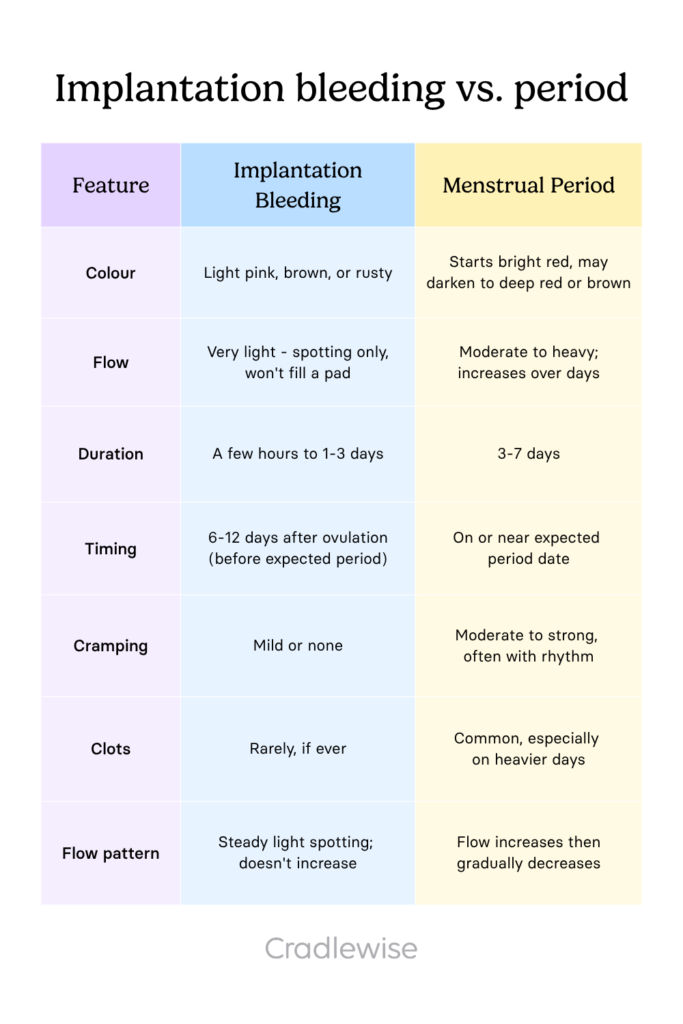
Sources: American Pregnancy Association
If what you’re seeing feels lighter and shorter than usual, and arrives a little early, it might just be implantation bleeding saying a quiet “hello.”
What to do if you think it’s implantation bleeding?
There is no specific medical treatment for implantation bleeding, but a few simple steps can help you stay comfortable and informed:
- Use a pantyliner, not a tampon. The flow is light enough that a pantyliner is all you need, and it lets you observe the colour and amount of spotting more accurately.
- Rest and avoid strenuous exercise. There is no evidence that activity causes implantation to fail, but if you feel more comfortable taking it easy for a day or two, that’s completely reasonable.
- Avoid alcohol. If pregnancy is a possibility, avoiding alcohol while you wait to test is a sensible precaution.
- Continue prenatal vitamins. If you’re trying to conceive, you should already be taking a prenatal vitamin with folic acid. Keep going.
- Take a pregnancy test at the right time. See the next section for when.
When should I take a pregnancy test?
If you think that faint pink or brown spotting might be implantation bleeding, the wait to take a pregnancy test can feel endless. You’re checking the calendar, second-guessing every symptom, and wondering, “Is it too soon?”
Dr. Miller says it’s best to give your body a little time before testing:
That said, it is also possible to get a positive test while implantation bleeding is still occurring, since hCG levels can become detectable as early as 10-14 days after ovulation. Dr. Stanhiser explains:
Cradlewise note: The most reliable approach is to wait until the day your period is expected or a couple of days after, then test with first morning urine as per the American Pregnancy Association.
When to call your doctor
Call your OB-GYN if:
- Heavy bleeding that soaks a thick pad in under an hour for one to three hours
- The bleeding is bright red and continues for several days
- Significant cramping or worsening pelvic pain
- One-sided pelvic pain, which can be a sign of ectopic pregnancy
- Shoulder pain, dizziness, or feeling faint
- A positive pregnancy test alongside any of the above
Dr. Miller reiterates: “If the bleeding is heavy, bright red, lasts several days, or especially if it comes with cramping or pain, call your doctor. That’s not typical for implantation and could mean something else, like an early miscarriage, infection, or abnormal implantation like in an ectopic pregnancy.”
The CDC also lists heavy bleeding as one of the maternal warning signs that deserve immediate attention. When in doubt, call. Providers would always rather reassure you than have you wait too long.
Conclusion
Light spotting around the time your period is due can mean many things including the beginning of a pregnancy. It can also be completely unrelated. The feelings that come with that uncertainty are real and valid, and there is no shame in counting the days and watching closely.
If you suspect that’s what you’re experiencing, give it a few days and take a pregnancy test once your period is officially late. Until then, care for yourself, watch what you’re seeing, and know that your doctor is there if anything doesn’t feel right.
FAQs
Q: How long after implantation bleeding can I take a pregnancy test?
A: Wait two to three days after the spotting stops, or until the day your period would be expected, whichever comes later. Testing earlier risks a false negative, since hCG may not yet be high enough to detect.
Q: How long after sex does implantation bleeding occur?
A: Sperm can live in the reproductive tract for up to five days. If fertilisation occurs, implantation takes another 6-12 days. So implantation bleeding, if it occurs, typically appears 7-17 days after intercourse, depending on exactly when ovulation and fertilisation took place.
Q: Can implantation bleeding contain clots?
A: Implantation bleeding is not typically associated with passing clots. Dr. Jamie Stanhiser recommends contacting your healthcare provider if you have a positive pregnancy test and are experiencing moderate to heavy bleeding or bleeding with clots, worsening pelvic pain, one-sided pain, dizziness, or feeling faint.
Q: Can implantation bleeding be heavy?
A: It would be quite unusual for implantation bleeding to be heavy. Heavy bleeding in the late luteal phase is usually the onset of menses. Dr. Jamie Stanhiser recommends to follow up with your healthcare provider if your pregnancy test is positive alongside bleeding.
Q: Can you get your period when you’re pregnant?
A: No. A true period involves the shedding of the uterine lining, which cannot happen once the lining is supporting a pregnancy. Light bleeding or spotting in early pregnancy is possible and often normal, but it is not a period.
Q: How long does implantation bleeding last?
A: It usually lasts one to three days and tends to be very light, more like spotting than a flow. If the bleeding continues for several days or gets heavier, it’s best to check in with your healthcare provider.
Q: What color is implantation bleeding?
A: Implantation bleeding is typically light pink, brown, or rusty red. It’s often much lighter in color and flow than a regular period because it involves only a small amount of blood from the uterine lining.
You may also like
- First-trimester exhaustion: Why pregnancy feels like running a marathon
- 13 Best pregnancy apps for new parents
- 15 Weird signs labor is near
Sources:
- What is implantation bleeding? American Pregnancy Association. What is implantation bleeding?
- When should I take a pregnancy test? American Pregnancy Association. Pregnancy Tests – Urine and Blood
- When to call your doctor. Centers for Disease Control and Prevention (CDC). 2024. Hear Her: Urgent Maternal Warning Signs and Symptoms


